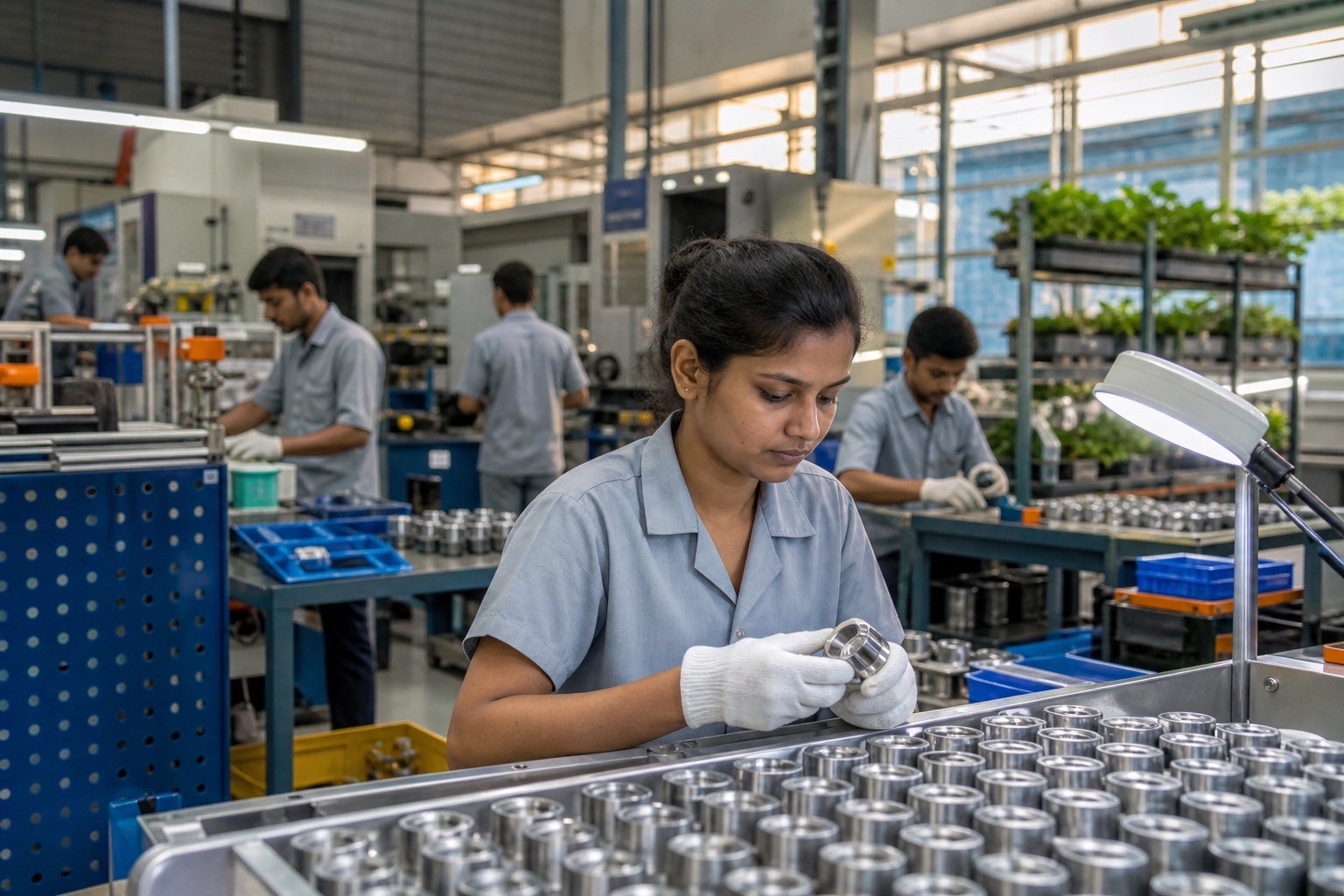
Zero Defect Zero Effect (ZED) is a Government of India certification scheme, run by the Ministry of MSME, that asks manufacturers to pursue two commitments together: Zero Defect — reliably high-quality products — and Zero Effect — minimal impact on the environment. MSMEs progress through Bronze, Silver and Gold certification levels, with government funding available to support the journey.
Key takeaways
- ZED is a graduated improvement journey — take the pledge, then certify at Bronze, Silver or Gold.
- All UDYAM-registered MSMEs are eligible; certification is assessed across up to 20 business parameters.
- The scheme funds up to ₹5 Lakh per MSME toward handholding and technology upgradation, with additional subsidies for eligible categories.
- Beyond the incentives, certification is a credible, exportable signal of quality and environmental responsibility.
For a small manufacturer in India, quality and sustainability can feel like abstract ideals that larger, better-funded competitors are better placed to pursue. The Zero Defect Zero Effect initiative was designed to change that. Envisioned by the Government of India, ZED aims to enhance the competitiveness of MSMEs, make them sustainable, and help transform them into national and international champions. It is, in essence, a structured, incentivised path to building a better business — one that produces reliably good products while minimising its impact on the environment.
Because the scheme is genuinely valuable but often poorly understood, this guide walks through what ZED actually is, how the certification levels work, what assessment involves, and — importantly for any owner weighing the effort — the financial support available. Note that scheme details are set and periodically revised by the Ministry of MSME, so treat the specifics here as an orientation and confirm current terms before you apply.
What "Zero Defect Zero Effect" really means
The name captures two commitments held together. Zero Defect is about the product and the customer: manufacturing quality goods using appropriate technology and tools, and continuously upgrading processes to achieve high quality and high productivity. Zero Effect is about the planet: achieving that quality with the least possible effect on the environment. ZED asks MSMEs to pursue both at once — to become more competitive without becoming more polluting.
The certification is an extensive national drive to create awareness of these practices among MSMEs and to motivate and incentivise them to adopt them, while encouraging them to become MSME Champions. It works through assessment, handholding, and managerial and technological intervention — so it is as much a development programme as a badge.
Who is eligible, and the ZED Pledge
All MSMEs registered on the UDYAM registration portal of the Ministry of MSME are eligible to participate and to avail the related benefits and incentives. The journey begins with the ZED Pledge — a pre-commitment, a solemn promise by the MSME to uphold the values of Zero Defect Zero Effect in its practices, and an undertaking to move forward on the ZED journey. Taking the pledge is the entry point; from there, an MSME can apply online for a certification level and must conform to all the requirements of the level it applies for.
ZED is not simply a certificate you buy — it is a graduated improvement journey that starts with a pledge and is supported by government funding. The certificate is the recognition; the real prize is a more competitive, more sustainable business at the end of it.
The three certification levels
After taking the pledge, an MSME can pursue certification across three progressive levels, each assessed against a wider set of the scheme's business parameters than the last.
| Level | Focus | What it demonstrates |
|---|---|---|
| Level 1 — Bronze | Parameters 1–5 | The foundations: leadership, a clean (Swachh) workplace, occupational safety, timely delivery and quality management. |
| Level 2 — Silver | Parameters 1–14 | Builds on Bronze, adding people and process management, planned maintenance, product quality, and material, energy and environment management. |
| Level 3 — Gold | All 20 parameters | The most mature and comprehensive adoption, extending to supply chain, risk and waste management, technology upgradation, resource conservation and CSR. |
An organisation applying for a particular level is assessed against a defined set of parameters, as applicable to that level. Crucially, the process is supportive rather than punitive: in the case of a non-conformity, the applicant MSME is given an opportunity to close it within a defined time period in order to become eligible for the desired level. The scheme is built to help you succeed, not to catch you out.
What the assessment looks at
Certification is granted on the basis of an assessment across a range of business parameters, applied according to the level sought. These span the way the organisation is led and run, the way it manages people and processes, and the way it addresses quality and environmental performance. Areas of focus typically include leadership and the overall management approach, the discipline of core processes, the systems in place for maintaining quality, and the measures taken to reduce environmental effect. In practice, preparing for ZED nudges a business to document how it works, measure how well it works, and improve where it falls short — which is valuable regardless of the certificate at the end.
Preparing for ZED forces the healthy questions every growing manufacturer should be asking anyway: how do we run, how do we measure, and how do we improve?
The financial incentives
One of the most compelling features of ZED for a cost-conscious MSME is that the government actively funds participation. The support is meaningful and, in several cases, enhanced for businesses that need it most. Figures below are per the Ministry of MSME's published ZED scheme guidelines on the official zed.msme.gov.in portal — confirm current terms there before you apply.
- Up to ₹5 Lakh of support per MSME has been made available for handholding and consultancy support to assist businesses through the ZED journey — a portion towards handholding through consulting organisations and a portion towards technology upgradation for moving to zero-effect solutions, subject to the scheme's approval process.
- An additional 10% subsidy for MSMEs owned by Women, SC or ST entrepreneurs, or those located in North Eastern, Himalayan, LWE-affected, island territories or aspirational districts.
- An additional 5% subsidy for MSMEs that are also part of the SFURTI scheme or the Micro & Small Enterprises Cluster Development Programme (MSE-CDP) of the Ministry.
- A limited-purpose joining reward of ₹10,000 offered to each MSME once it takes the ZED Pledge.
Source: Ministry of MSME, ZED scheme guidelines (zed.msme.gov.in). Taken together, these provisions mean the cost of pursuing ZED can be substantially offset — and, for many eligible enterprises, the pledge itself carries an immediate, if modest, reward. Because the exact quantum, split and approval mechanics are defined by the Ministry and can change, it is worth confirming the current provisions when you apply.
Why it is worth it: competitiveness and exports
Beyond the incentives, the strategic case for ZED is straightforward. The scheme is expressly designed to develop an ecosystem for ZED manufacturing among MSMEs, enhancing competitiveness and enabling exports. A recognised, credible mark of quality and environmental responsibility helps a small manufacturer stand out — with larger domestic buyers who increasingly screen their supply chains, and with international customers for whom such standards are often a precondition of doing business. In a market where buyers have choices, being demonstrably a Zero Defect, Zero Effect supplier is a genuine differentiator.
For most MSMEs, the hardest part of ZED is not the ambition but the navigation — knowing which level to target, preparing against the parameters, documenting processes, and closing any non-conformities within time. This is precisely where structured handholding support, of the kind the scheme itself funds, makes the difference between an intention and a certificate on the wall.